Play with a Purpose
How to Use Dollhouses to Develop & Increase Speech, Language, & Communication Skills
Many parents often ask me, “should I put my child in a more structured preschool or play-based preschool” and my answer is “you need to determine what is best for your little one.” There are benefits to both styles of learning, but personally, when I think of kids, I think of play. Play is such an important part of our lives. Not only does it bring joy and connection, but it expands our awareness about the word we live in.
Play is critical to development, it builds the foundation for our kiddos to become curious, to explore and to become active little learners. Play also helps to develop language skills, fine motor skills, social skills, attention and leads to discovering a deeper sense of self and others. According to the NAEYC “the impulse to play comes from a natural desire to understand the world.” Play-based learning is type of teaching and learning style, where the child often leads and there is more of an open-ended structure. Using play-based learning is a wonderful way to encourage many areas of development, including speech, language and communication.
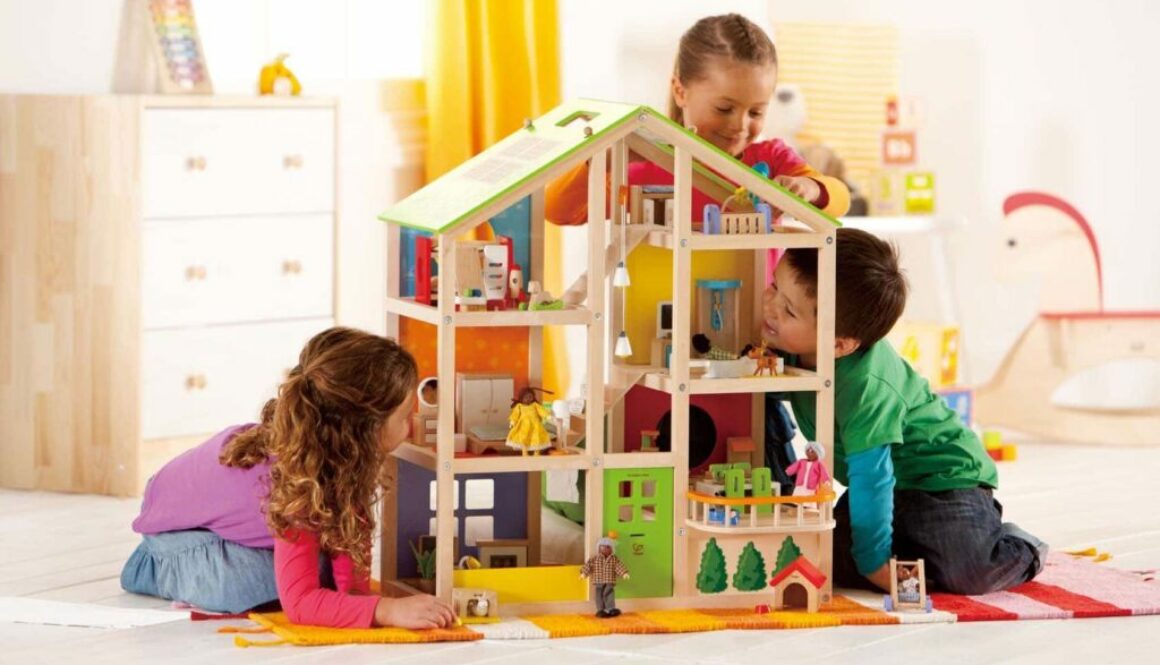
One of the many ways you can incorporate play into your kiddos daily life is through playing with dollhouses. Dollhouses not only spark the imagination and ignite tons of fun, but it is a great way to take a functional, real life situation and turn it into play! Dollhouses are one of my favorite toys to utilize in my sessions with our kiddos because it is engaging, fun and versatile! Little ones begin to demonstrate pretend play skills between 12-18 months of age so you can jump right into connecting with your little one and the two of you can play with a purpose!
Below are some wonderful way to target speech, language and communication development while playing house. You can do this with a dollhouse, with a pretend house or kitchen playset, and even during daily routines around the house! Have fun!
- Vocabulary: Work on functional vocabulary (receptive and expressive), such as family members, furniture, rooms in a house, items around the house, etc. (bonus tip: this is also a great way to work on categories!)
- Requesting: Your child can request by pointing or signing or using verbal communication (words, short phrases, or sentences) depending on their age and/or the level of their abilities
- Pronouns: Work on identifying and using boy/girl, he/she/they, his/hers/theirs while answering questions
- Prepositions/Spatial Concepts: Work on identifying spatial concepts through following directions (examples: put the pot on the stove, put daddy behind the couch. You can also work on using prepositional phrases by asking “where” questions (i.e. where is daddy).
- Answering WH-Questions: Work on “who,” “what,” “where,” “when,” and “why” questions while playing with the dollhouse (examples: who is sleeping, where is the baby, what is daddy cooking, when do you brush your teeth).
- Turn Taking: Practice turn taking during social routines, like feeding the baby. This is also a great time to work on “my turn” and “your turn.”
- Social Routines: This is a great opportunity to teach and practice social routines, like greetings (knock on the door and have two dolls greet each other), asking questions (daddy doll asks mommy doll “what do you want to eat”), bath time routines, etc. (bonus tip: also a great way to work on sequencing!)
Nowadays, you can find your kiddo’s favorites on almost any house, whether it be a firehouse, Barbie House, or just your classic dollhouse, you can find houses of various shapes, sizes and themes, making this activity fun for ALL kiddos.
When selecting toys for your kiddos, it is always important to consider choosing toys that inspire creativity and empower self-expression, making any dollhouse one of the perfect choices for your little one!

Sholeh Shahinfar, MA, CCC-SLP, RYT
Sholeh Shahinfar is the Founder of Valued Voices, a licensed Speech Language Pathologist, Child Communication Specialist and Certified Oral Motor Therapist. She is passionate about uplifting children’s voices in the world and inspiring self-expression. In her free time, Sholeh embraces a vegan lifestyle, loves going to the ocean, exploring nature with her pup Kobe, practicing yoga, traveling, and spending time with her loved ones.