Oftentimes parents ask me, “Why would my child need OT in a clinic setting, if they receive OT as part of their IEP?”. This is such a great question! Occupational therapy is such a wide-reaching profession, that it sometimes seems like all settings are the same. In actuality, there is a big difference in the scope of practice depending on the setting. Let’s break down the difference below!
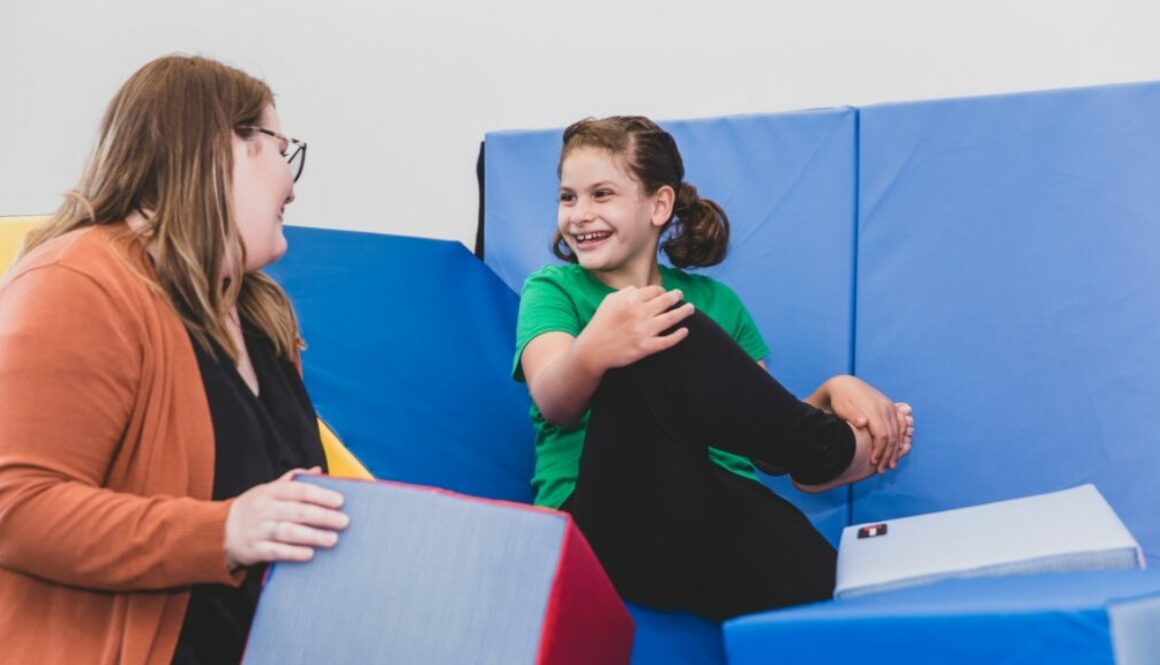
Sessions typically occur in a specialized clinic setting with swings, slides, climbing equipment, and games. Parents are invited into the sessions to learn ways to work on skills outside of the session. The frequency and duration of sessions are based on recommendations from the therapist at the start of intervention, but can be adjusted to a child’s schedule as needed. Therapists can also perform occasional classroom observations to support the child if needed. Typical frequency/duration is 30-60 minutes per week of direct services (i.e. one therapist working with one child for that length of time).
Skills Addressed:
Dressing: putting on and taking off clothes, tolerating clothing textures, fastening buttons and zippers, tying shoelaces
Hygiene Routines: Toileting, teeth brushing, showering and bathing, hand washing, flossing, hair washing, etc.
Feeding: using a spoon, using a fork, using a knife, tolerating food textures, trying new foods
Play Skills: Cooperative playing with others, frustration tolerance, following group instructions, playing in a variety of settings (i.e. sand, grass, play structures, etc.)
Fine Motor Skills: Handwriting, pre-writing shapes, scissor skills, coloring, opening food packages, pencil grasp, etc.
Sensory Processing: Being able to handle all aspects of a child’s daily routine (all the tasks- and more- listed above) without becoming overwhelmed or upset. Being able to sit and attend to daily tasks without needing to get up and move, and being able to tolerate change in routines.
What a Session Looks Like?
At Valued Voices, our sessions are designed to meet the needs of the child and their family. Parents are invited to participate in the sessions, but if this is not possible, a detailed report is provided after each session. The activities are all child-friendly, encourage movement, and are adaptable to your child. They take place in both the clinic gym, and the fine motor room, and can include obstacle courses, fort building, swings, board games, crafts, and more!
Funding:
Typically outpatient services are funded by medical insurance or private pay.
School-based occupational therapy:
Place:
Sessions can occur in your child’s classroom or in an occupational therapy office. Sessions can also take place in a group format or individual format (one therapist to one child). Therapists are a part of the IEP or 504 team, and are mandated to fulfill the service requirements outlined in the IEP/504 plan. The frequency and duration of services remains the same until the next meeting with the team. The duration/frequency typically ranges from consultation (i.e. the therapist meets only with your child’s academic team and no direct service is provided), to 15-60 minutes per week. This can vary, though, depending on the child’s needs.
Skills Addressed:
Fine Motor Skills: Handwriting, pre-writing shapes, scissor skills, coloring, opening food packages, pencil grasp, etc.
Access to the academic curriculum: This basically means making sure your child can participate in the school day to a functional degree. This may include adapted seating, accommodations for breaks and regulation strategies, or extra time for test taking. School based occupational therapists can suggest tailored accommodations to make the school day functional for your child.
What a Session Looks Like?
The therapist arrives at your child’s classroom and will conduct the session during the school day. The sessions focus mainly on the goals included in the IEP/504 plan. Activities include specific games, movement activities, writing tasks, typing, and crafts geared towards boosting skills in a fun way.
Funding:
School based occupational therapy services are financed through the state, and are free for students in public schools if they qualify.
Ultimately, both school based and clinic based occupational therapists are dedicated to adapting your child’s environment to their skills, while fostering growth and independence. Oftentimes, children receive both types of services to make progress in both the school setting and the home/community settings. If your child is in need of support, it’s important to determine where they are having trouble (i.e. school only, or school, home, community) and where the challenges arise (i.e. daily routines, during the school day, outings with family, etc.) to best determine which type of occupational therapy to pursue. If clinic based occupational therapy seems to meet the needs of your child, reach out to us for a complimentary consultation!
Sholeh Shahinfar is the Founder of Valued Voices, a licensed Speech Language Pathologist, Child Communication Specialist and Certified Oral Motor Therapist. She is passionate about uplifting children’s voices in the world and inspiring self-expression. In her free time, Sholeh embraces a vegan lifestyle, loves going to the ocean, exploring nature with her pup Kobe, practicing yoga, traveling, and spending time with her loved ones.
KAELYN GREEN
Kaelyn Green is a licensed occupational therapist at Valued Voices. She is certified by the University of Southern California in Sensory Integration and is an advocate for addressing underlying sensory functioning in order to improve occupational performance. She is passionate about meeting children and families where they are at and seeks to tailor interventions to the unique needs of her clients. When she is not working, you will find Kaelyn taking care of her two goldendoodles, working in her garden, or taking trips to the Central Coast.
What are the stages of gestalt language development?
If you are curious to learn more about the six stages of gestalt language development, please click the button below.
Learning language is a process that starts during your baby’s development in the womb. And from the moment your baby is born, they begin expressing themselves. First through cries and smiles, then with coos and gestures, which leads into babbling. You long for that day for those babbles to turn into first words. While we cannot rush our little one’s on their journey of self-expression, we can certainly encourage their language development and provide an environment that empowers their expression.
Here I will share with you 10 simple strategies to help boost your baby’s language development. The best part is, these tips can be used in every day life and situations that are happening all the time! So, no need to stress yourself out and feel like you are adding something to your already busy to-do list. Just give yourself the daily reminder that language opportunities are happening all the time.
1. Connect with your baby.
This is one of my best tips! Now read carefully, because there are a few layers here. In order for your baby to listen, they must be paying attention, and in order for them to be paying attention, they must be engaged and where does this all begin? CONNECTION. Babies communicate with us almost instantly after birth when they give us eye contact. Eye contact is one of the foundational ways in which most children learn about the world around them. Connect with your baby and get them engaged and motivated to learn. This is the foundation of speech and language development, and everything to follow!
2. Talk with your baby.
This is a very easy and connected way to help your baby’s language development. Babies learn language by hearing it first. Using simplified language and familiar words to help your baby hone in on the key words is great and so is using the full sentence, I like to use a combo approach. Bonus tip: repetition is key! Talk to your baby all day long! Remember, use simple sentences and vocal intonation to keep your kiddo engaged and make things fun. Healthy speech development starts with a few words and just goes up from there.
3. Narrate to your baby.
Talk to your baby about the day. Talk about what your baby is doing and talk about what you are doing. Bonus tip: using daily routines is great because it allows your baby to hear the same words over and over again. This is a great way to build neural connections and increase your baby’s language development. Most young children, around their first birthday, begin to use their first words. The more language they hear, the more inclined they are to repeat and that is why narrating in early childhood is such an important tool in supporting your child’s speech and language developmental milestones!
4. Give your baby feedback.
Giving your baby feedback is a wonderful way for your baby to learn language. You may be thinking “how is my baby going to understand when I tell them good job?” Well, it is all in the way we are celebrating our little loves. Celebrate the successes, and this includes acknowledging all the attempts and efforts. When young babies are learning to talk, they will not say words perfectly, for example, “water” may be “wa” or “wawa” and this is perfectly okay! Clap your hands, do a happy dance, sing songs, give a high-five or a hug, whatever fun way you want to show it, just celebrate it!
5. Use a different pitch.
Parentese is the sing-song way we speak to our babies. Parentese is used across many cultures and has so many benefits for language development and learning. Research has shown that parantese increases blood flow activity to your baby’s frontal cortex of the brain, sustains and grabs your baby’s attention, and helps your baby engage in prelinguistic skills such as joint attention (just to name a few). Bonus tip: speak slowly and clearly, use exaggerated speech sounds, and repeat, repeat, repeat!
6. Read to your baby.
Book reading is important at every age and there is no such thing as starting too early! Research has shown that book reading helps increase your child’s development in so many areas! Maybe your little one doesn’t understand all the words yet, but that’s okay! Secret tip: you actually don’t have to even read all the words! Make book reading fun! Get animated, use facial expressions, act out the story, make noises that may go with the story, and label objects and things happening the picture! Storytime is a wonderful way to connect and bond with your baby. Read more here.
7. Play with your baby.
Play is one of the most important ways we learn. We learn through experience, so get down on the floor, get outside, get creative and PLAY! This is another great way to boost you child’s development across so many areas! There are so many benefits to play, some of which include: increased imagination and creativity, increased social-emotional development, increased physical and cognitive development and a way to interact with the world that allows for exploration through the senses. Play is great because it incorporates so many modalities of learning, including motor movements, visual skills, social-emotional skills, problem solving and of course so many opportunities for language learning! Learn more about the connection between play and language development here!
8. Let your baby lead.
Following your baby’s lead is a great way to understand their likes and dislikes. It gives you an opportunity to see how your baby interacts with the world around them and gives your baby the opportunity to grow! When you are out for a walk and your baby points up to the airplane in the sky, follow your baby’s verbal and visual cues by labeling and expanding “Airplane. Fast airplane.” Letting your baby lead means really staying present and connected to what your baby is doing in all moments, and chances are, all these precious moments are filled with language boosting opportunities!
9. Give your baby choices.
This is such an important tip, but sometimes the hardest for parents to follow. As a parent, you know exactly what your baby wants and needs and so when you see your little one is getting a little worked up, you give them exactly what they need to feel comfort and calm. Although this is absolutely incredible, it sometimes also becomes a missed opportunity for language. Before your little one gets into a distressed state, give them a choice: “do you want apples or banana”-it would be ideal if you can hold up each object as you name it too! When your child is presented with a choice, they are more likely to communicate their wants and needs because they need to indicate to you their choice! Remember, there are many forms of communication, if you baby looks at the object, points to it, or tries to label it those are all great ways to communicate. When giving your little one choices, first make sure that your baby understands the vocabulary. Also, get creative! Communication comes in so many forms and is not just talking. I love to use both verbal and visual cues to help support a child in their speech sounds and language development. Bonus tip: if your baby points to the apples, hold the apple close to your mouth and say “A-PO” and really exaggerate your mouth movements. Try 1-3 times and see if your kiddo imitates, if they don’t, give them a little piece of the apple and try again! This simple snack activity turns into a teachable moment where you are taking each apple slice (maybe up to 10 slices or 20 chunks of apple) to target the sound “a”, the word “apple” or maybe even the phrase “more apple” with your little one! Another example: if your little one wants milk, rather than giving your baby a bottle when they cry, ask them if the would like “more milk” and then encourage their participation in choosing it. This takes a bit of practice and rewiring, but once you get it down, you will see how great it is in encouraging your little one’s speech and language skills.
10. Expand your baby’s language.
Language expansion is a great tool to help your little one develop their expressive language skills. Expansion is when you take what your little one is saying and then add more language to it. When your little one is talking using 1-2 words to communicate, you can imitate what they say and then expand it. For example, if your little one says “car,” you can expand by saying “yes, that’s a green car.” If your little one says “more juice,” you can say “want more juice, okay-here you go!” Putting emphasis on certain words and using parantese (see tip number 5), helps draw your little one’s attention to new words and keeps them engaged!
Language opportunities are happening around you and your kiddo all the time. Now that you have become more aware of these natural moments, you will be more present to when they are happening. Remember, your little one’s speech and language develops in its own time, so just be patient and trust the process. Plus, you now have 10 wonderful ways to boost your kiddo’s language in any given moment! So, print these tips out, put them on the fridge and have so much fun connecting with your kiddo!
Sholeh Shahinfar is the founder of Valued Voices, and a licensed Speech Language Pathologist, Child Communication Specialist and Certified Oral Motor Therapist. She is passionate about uplifting children’s voices in the world and inspiring self-expression. In her free time, she loves going to the ocean, exploring nature with her pup Kobe, and spending time with her family and friends!