They absolutely could be! A child does not need to be using words to be identified as a Gestalt Language Processor (GLP).
Personally, at Valued Voices, we don’t align with words terms like “non-verbal,” but we do recognize this may be a term you have heard somewhere else. Instead, we like to use terms like “non-speaking” or “minimally speaking.” Because, in truth, verbal does not just mean the words that come out of our mouth, verbal means so much more and so our strong belief is that everyone is verbal. In this post, when we talk about non-speaking, we are specifically talking about those words that come out of our mouth.
Now let’s take a closer look into some information to help guide you in determining if your child may be a GLP:
Your child may hum or sing songs but is not using “words.”
Your child’s speech & language has rich intonation, but their longer strings of utterances are not easily understood. Here, you may notice that the intonation they are providing sounds familiar (like from a certain song or scene from a movie), but you can’t understand it clearly.
Your child is using single words, but they are not combining them to expand their utterances.
Your child replays clips from movies, videos, songs, and/or TV shows. They use scripts from these parts of the clips to communicate.
If using AAC, your child is not making much progress as most AAC devices are programed for analytic language processors, using single words (instead of phrases) to build sentences. You may find here that your child is again using single words but not expanding beyond that.
Acknowledge all forms of your kiddo’s communication, even if you can’t understand it.
Do the digging to find out which sources your child’s long, repeated strings are coming from and watch them to get better insight into what your child is actually trying to communicate with you.
Affirm and model language for your child. If your child is using an AAC device, you should also still be modeling on the device and through spoken words. Model what you think your child is trying to say, even if you are guessing and always model functional, everyday language.
If you are considering introducing AAC to your child…do it! Age, cognitive abilities, attention…none of this matter when it comes to AAC as there are no prerequisites. AAC has been shown to improve:
Behavior
Attention
Self-Confidence
Regulation
Independence
Participation
Social Interactions
When considering AAC to a gestalt language processor, it is important to add personalized gestalts/scripts onto the device. Instead of using single words, adding phrases will help your child mitigate gestalts when moving into other stages. It is important for your child to hear functional, every day and meaningful language, so model gestalts on the device and say them out loud. It is important to program gestalts and model them (both on AAC and out loud) across different language functions and across various settings and contexts. For example, program gestalts for protesting, shared joy, requesting, etc. and across various settings/contexts, such as mealtime, playtime, transitions, etc.
Curious in learning more about GLP?
If you are wondering if your kiddo may be a GLP, book a complimentary consultation with me today so we can dig deeper into your child’s strengths.
Sholeh Shahinfar is the Founder of Valued Voices, a licensed Speech Language Pathologist, Child Communication Specialist and Certified Oral Motor Therapist. She is passionate about uplifting children’s voices in the world and inspiring self-expression. In her free time, Sholeh embraces a vegan lifestyle, loves going to the ocean, exploring nature with her pup Kobe, practicing yoga, traveling, and spending time with her loved ones.
KAELYN GREEN
Kaelyn Green is a licensed occupational therapist at Valued Voices. She is certified by the University of Southern California in Sensory Integration and is an advocate for addressing underlying sensory functioning in order to improve occupational performance. She is passionate about meeting children and families where they are at and seeks to tailor interventions to the unique needs of her clients. When she is not working, you will find Kaelyn taking care of her two goldendoodles, working in her garden, or taking trips to the Central Coast.
What are the stages of gestalt language development?
If you are curious to learn more about the six stages of gestalt language development, please click the button below.
Toys are not just objects of play; they are powerful tools that hold the key to unlocking a world of possibilities, especially when it comes to speech and language development in children.
You may have recently been at a toy store or Target and when you went into the toy aisle, you were bombarded with lights, sounds, colors, buttons, music and oh so many screens! When you purchase these types of toys, the toys are doing all the work! This means, your child is not really using or building on any of their skills. Children learn by doing, and with these toys, often instead of them doing (and learning), the toy is doing!
There are two things I almost always tell parents: keep it simple and less is more. The simpler the toy, the more skills you can work on. However, it is always important to go with your child’s interests, so if your child likes the loud toys, don’t shy away from getting them, but always try to mix in some more simple toys into your child’s toy collection to support the development of early language and play skills. Also, you don’t need a closet full of toys to have fun, you can use one toy to target so many things, all while connecting with your kiddo, keeping their attention and having tons of fun!
In this blog, we delve into the incredible journey toys and using a single toy to encourage and enhance speech and language skills in young ones.
The Magic of Interactive Play
At the heart of speech and language development lies the foundation of interactive play. A simple yet versatile toy, such as building blocks, cars, ball drops. shape sorters and even books, can work wonders in engaging children in meaningful interactions. Through play, children learn to communicate, express themselves, and comprehend language in a natural, enjoyable way.
Choosing the Right Toy
When selecting a toy to aid speech and language development, consider its versatility and adaptability. A toy like a set of animal figurines or a dollhouse not only sparks imagination but also offers endless opportunities for vocabulary expansion, storytelling, and social interaction – all essential components of language growth.
LEGOS & BLOCKS
An oldie but goodie! Because they can be used in so many different ways, Legos are one of the best toys for development. Children can play independently or interact with others. Great for vocabulary, language skills, articulation, and building fine motor and spatial awareness skills.
MR. POTATO HEAD
This toy provides so many benefits, including encouraging language development (naming body parts and labeling colors) fine and gross motor skills (grasping), visual scanning (looking for a part), naming body parts, spatial awareness, matching objects, and labeling colors, just to name a few! At Valued Voices, we have a variety of sizes of Potato Heads, which provides great opportunities during peer play too!
BOOKS
Reading at an early age is so important for your little one. Children can build their literacy skills, which will directly correlate to language development and later success. Wordless picture books, simple books with short phrases and sentences, and books with repetitions are my favorite. You can find out more about the importance of reading with your kiddos here.
CAUSE-EFFECT TOYS
Cause and effect toys offer more than just entertainment; they provide valuable developmental benefits for children. By engaging with these toys, kids learn about the relationship between actions and outcomes, enhancing their cognitive skills and problem-solving abilities. Additionally, cause and effect toys promote sensory exploration, fine motor skills, and foster creativity. Investing in these toys not only sparks curiosity but also lays a strong foundation for learning and development in early childhood. Check out my favorite car ramp, piggy bank, and more. I also have some of my favorite toys listed by age here.
Playful Language Learning Activities
Here are some fun and creative ways to harness the power of a single toy for speech and language enrichment:
1. Labeling and Describing:
Prompt children to label and describe different parts of the toy or describe its features, building vocabulary and language comprehension.
2. Pretend Play & Storytelling Sessions:
Encourage children to narrate stories using the toy characters or props, fostering creativity and narrative skills.
3. Role-Playing Scenarios:
Engage in role-playing activities with the toy to stimulate conversation, practice social skills, and enhance communication abilities.
The Impact Beyond Words
Speech and language development go beyond words – they form the cornerstone of cognitive, social, and emotional growth. By incorporating a thoughtfully chosen toy into a child’s play routine, you’re not just fostering language skills; you’re nurturing their overall development and setting a strong foundation for lifelong learning.
The power of a single toy in encouraging speech and language development is immeasurable. We don’t need always need more; we just need the right way to unlock your child’s strengths! Through toys, children can embark on a journey of self-expression, communication, and connection. So, grab that toy, ignite the magic of play, and watch as language blossoms in the hands of little ones.
Remember, in the world of toys, every play moment is a language moment waiting to happen. Celebrate achievements, no matter how small, to boost confidence and motivation in your child’s journey of self-expression!
Sholeh Shahinfar is the Founder of Valued Voices, a licensed Speech Language Pathologist, Child Communication Specialist and Certified Oral Motor Therapist. She is passionate about uplifting children’s voices in the world and inspiring self-expression. In her free time, Sholeh embraces a vegan lifestyle, loves going to the ocean, exploring nature with her pup Kobe, practicing yoga, traveling, and spending time with her loved ones.
KAELYN GREEN
Kaelyn Green is a licensed occupational therapist at Valued Voices. She is certified by the University of Southern California in Sensory Integration and is an advocate for addressing underlying sensory functioning in order to improve occupational performance. She is passionate about meeting children and families where they are at and seeks to tailor interventions to the unique needs of her clients. When she is not working, you will find Kaelyn taking care of her two goldendoodles, working in her garden, or taking trips to the Central Coast.
What are the stages of gestalt language development?
If you are curious to learn more about the six stages of gestalt language development, please click the button below.
Have you ever wondered at what age your child should be making certain sounds? Or maybe you have wondered why your child is mispronouncing some sounds but not others. Maybe others are having a hard time understanding your little one, and you are left wondering what you can do to help improve your child’s speech. At Valued Voices, our self-created Articulation Screenerhelps answer these questions for you. Articulation screeners are a great tool used by Speech Language Pathologists (SLPs) to identify which sounds your child can or cannot say and to determine if your child’s errors are developmentally appropriate or if they can use some support in the area of speech sound production. It is important to note, that a screener is a not a standardized evaluation, if this is needed, your SLP will certainly guide and support you in this direction.
Before we get into the details of articulation, articulation therapy and tips to support your kiddo, please understand that there are several other factors that can impact speech intelligibility, including but not limited to, hearing loss, oral motor deficits, sensory issues, and apraxia of speech. We will not be addressing any of these in this article.
Does your child have difficulty saying certain sounds? Is your child’s speech difficult to understand?
Children who demonstrate difficulty producing particular sounds and have difficulty being understood by others would likely benefit from a type of speech therapy referred to as articulation therapy.
Articulation is part of the “speech” side of speech and language therapy that involves the movement of our articulators (i.e. lips, tongue, teeth, jaw) to form speech sounds. Articulation disorders are characterized by the inability to properly form speech sounds, and can include one or more of the following production errors:
Substitutions: “tat” for “cat”
Omissions: “uh” for “up”
Distortions: “thoap” for “soap”
Additions: “buhlack” for “black”
Different sounds are acquired at different ages of acquisition, meaning each sound is expected to emerge and be mastered by a certain age. For a free copy of our speech sound chart, sign up for our email list today!
What is a Phonological Process?
Phonological processes are patterns of sound errors that children use to simplify speech as they are learning to talk. Complex words are simplified in a predictable way until the coordination of the oral motor muscles (i.e. tongue, lips, jaw, teeth, palate) develops to articulate clearly. For example, your child may produce “banana” to “nana” or “bue” for “blue.”
Phonological processes are considered age appropriate, until they persist beyond a certain age. For example, if your 5 year old still uses the phonological process of “fronting” (saying “tootie” for “cookie”) that would be considered delayed since most children eliminate that process by the time they are 3.5 or 4 years of age Further, a phonological delay may be considered if your child is using patterns of speech that are not expected in speech development.
If your child is using multiple phonological processes together, this usually decreases your child’s intelligibility, making them difficult to understand. Depending on the severity of your child’s overall intelligibility, this can result in in frustration, decreased motivation to communicate, and low self-esteem. An SLP can guide you and your little one by giving you strategies and exercises to help and to empower your child’s voice, because every voice deserves to be acknowledged.
If you’re uncertain how intelligible your child should be based on their age, take a look at our chart below. As always, keep in mind, milestones are meant to be a guide to support you and your kiddo. Each child has their own set of unique strengths and ways of developing.
Articulation Delay or Phonological Disorder?
Sometimes, it can be tricky to know if a child presents with an articulation delay or a phonological disorder, both of which are considered speech sound disorders. To put it simply:
Articulation disorders manifest when a child has difficulty producing a certain sound (or sounds) and can be remediated by addressing the sounds in error.
Phonological disorders are more complex, they are patterns in a child’s speech used to simplify speech sound production. Many children with phonological disorders present with unintelligible/unclear speech as they often present with multiple speech sound errors and phonological processes.
So, to sum it up:
A speech sound disorder is considered an articulation disorder when:
Speech sound errors persist beyond the average age of mastery
Intelligibility is mild to moderately impacted
A speech sound disorder is considered a phonological disorder when:
Phonological processes persist beyond the average age of elimination
Phonological processes/patterns are used that are not usually seen
Intelligibility is highly impacted due to use of multiple phonological processes
Remediation or therapy for each speech sound disorder will vary depending on each child’s case. Typically, children with an articulation disorder respond well to articulation therapy where sounds in error are targeted one or two at a time. Now, let’s dive a bit deeper!
What Does Articulation Therapy Look Like?
The first thing we want to know is what sounds is your child having difficulty with, most parents usually can list this without a problem. Here comes an extra layer: do you know what position of the word (beginning, middle, or end) your child is having difficulty with and do you know what sound they are substituting in its place? With a screener and/or formal articulation evaluation, an SLP can help answer these questions for you. But what’s next? Here are a few things we need to know:
Stimulability: Is your child stimulable for the sound given a direct model, meaning if they say “tea” for “key” and you give them a model for /k/, can they produce the sound with direct imitation? If so: CELEBRATE! This is a huge first step. If your child cannot imitate the sound, no need to worry, that just means we will have to do a little extra work with the articulators (tongue, lips, jaw palate, teeth, etc.) to get them just in the right spot, this is referred to as elicitation.
After a sound is learned, meaning your kiddo can imitate the sound, then practice the sound in isolation. Practicing a sound in isolation means saying the sound without adding a vowel. So, in our example above, your child is no longer producing “kuh” but they are just producing /k/ in isolation. Once your child can successfully repeat the sound with 90% accuracy, over a few times of practicing, you can move on.
After the step of isolation, move the target sound to syllables. This means that you are putting vowel sounds before and/or after the target sound, make sure to use all the vowel sounds-long and short. I always start where my kiddo is most successful. Taking our example target sound /k/, here is what this may look like:
o Initial Syllable Production: kee, koo, kay, ki, etc.
o Medial Syllable Production: akee, okoo, eekay, ooki, etc.
o Final Syllable Production: eek, ook, ak, ik, etc.
Once your kiddo can say the sound in syllables, you can move onto sounds in words, again, we are targeting all positions that are in error.
From there, you can move onto sounds in phrases, sentences, stories, conversation and finally…GENERALIZATION! Generalization is when your child uses their target sound across all contexts of language and with various communication partners.
How do I Support My Kiddo’s Speech at Home?
Articulation practice is all about teaching new motor patterns of our mouth, and to establish a new motor pattern you need daily practice! Spending 5-10 minutes a day, every day to practice these new motor patterns can significantly increase your child’s progress with their articulation skills. Below are some fun and engaging ideas to work on your child’s speech skills at home or on the go when they are not in speech therapy:
I Spy: This is a fun way to work on a target sound or sounds, while keeping it engaging for your kiddo! This is a great game to play in the car, on a walk, or in the comfort of your home.
Charades: Take turns acting out target words and guessing what the word is, this is great articulation practice!
Crafts: Make a craft (painting, necklace, flower crown, superhero cape, etc) and for each piece of the craft, practice your target sound.
Flashlight Search: Tape target words to the wall, turn off the lights and use a flashlight to find the words.
Roll-A-Dice: Roll a dice and say your target word that many times (you can use include this trick for any of the activities suggested here).
Scavenger Hunt: Search your home, park, restaurant, store, or car for things that include your target sound! Take a picture or draw the item to create your own sound book or self created worksheets! Then, practice the entire list including all your speech sounds.
Stacking Cups: Tape target words into cups and build a tower, see how many words you can say and cups you can stack before it falls down!
Bowling: Tape target words to the bottom of bowling pins or plastic cups and say the words that you knock over!
Basketball: Write down targets on a piece of paper, say the word, crumple up the paper and toss it in the hoop. If you want to bump it up and have your kiddo work on the next level (word, phrase, sentence, conversation), you can make those worth more points!
Picture Collage: Cut out pictures from magazines of things that include your kiddo’s target sound.
Mystery Box: Place items or photos that include your child’s target sound in a box, shake it up, describe it and have your kiddo guess what the object is using correct articulation.
Categories: Pick a category and name as many items in that category as you can that contain your target sound.
Go Fish: Use target sounds, making two copies of each word and play Go-Fish while your kiddo practices their target sound (you can use the same cards to play Memory too!)
Board Games: You can use any board game and practice target sounds on each turn.
Books: Using books is not only a great way to work on target sounds, but it is great way to work on language skills too!
Equally, if not more important than the fun games, is making sure we understand a few key elements that are necessary in establishing articulation practice at home:
Make speech therapy practice as part of your daily routine
Keep it short, aiming for 5-10 minutes a day. If you get at least 3 good practice times in over the week, you are significantly boosting your child’s progress towards their goals.
Frequency over duration! Three times a week for 10 minutes is better than one time 30 minutes.
Make it fun! Get the entire family involved or make it a special time with you!
Meet your child where they are at. Articulation is a hierarchy and so it is important you be practicing at just the right step for your child. If your child is in speech therapy, be sure your SLP is guiding you on exactly what level you should be practicing at home.
I always explain to families that although articulation seems simple, it in fact includes many layers and nuances that can make it quite complex. As always, if your child is having difficulty in this area, consult with a professional for some added support and see if speech therapy is right for your child.. Every child’s voice deserves to be heard and acknowledged, and with your help and support I know they will!

Sholeh Shahinfar is the founder of Valued Voices, and a licensed Speech Language Pathologist, Child Communication Specialist and Certified Oral Motor Therapist. She is passionate about uplifting children’s voices in the world and inspiring self-expression. In her free time, she loves going to the ocean, exploring nature with her pup Kobe, and spending time with her family and friends!
With the holidays upon us, there are so many wonderful ways we can celebrate and show each other love. If one of your ways to show love is by giving gifts then this guide is for you!
I am breaking the gift guide into age groups and providing you with some of my favorite toys that target:
speech and language development
play skills
fine motor skills
social skills
problem solving skills
hand eye coordination
gross motor skills
cognitive development
sensory input
social interaction
AND SO MUCH MORE!
Click on the links to take you to the exact item in the guide! BONUS: almost all gifts are under $30!
Mini sensory books are a great way to begin introducing your little ones to the wonderful world of literacy! These books not only provide great visual stimulation, but great tactile stimulation too! Your child will learn through touch and exploring their senses! Make sure to model vocabulary like nouns, animals, and body parts. BONUS TIP: when you are reading with your child, use animated facial expressions to make it fun! Learn more about reading with your kiddo here.
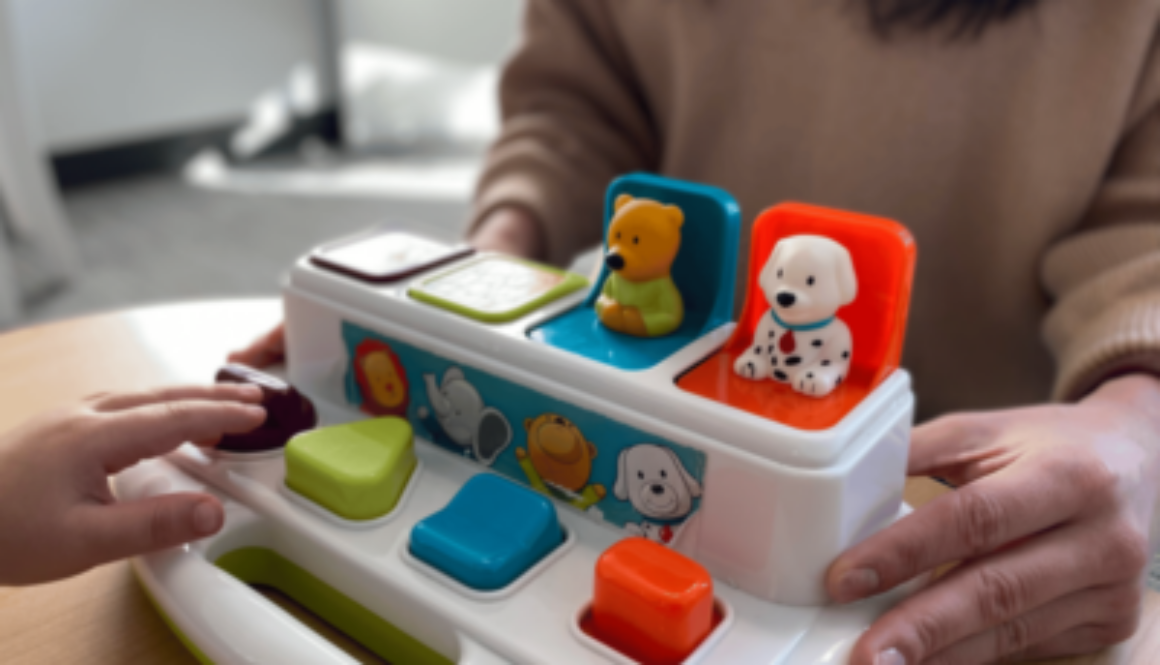
Great cause and effect toy and fun for so many kiddos! Model how to use it for your little one and model new vocabulary like colors, actions, and prepositions. This is also a great way to target joint attention, eye contact, and fine motor skills.
At this age, kids love to pick things up and bang things together. As they get a bit older, they will love to begin stacking and making tall towers! This simple toy is a fun way to target fine motor skills, as well as identifying new vocabulary.
Similar to our stacking blocks, stacking rings are another one of those simple toys that children love! Model descriptive words like colors and different word types like action words and prepositions. This is another great way to boost your child’s vocabulary while engaging in play with a classic toy!
This toy is a great motivator to promote speech sound development, language learning, and joint attention It is also great practice for spinning and reaching. Because of all the fun colors, playing with this toy provides great visual input without being overly simulating.
This is one of my favorite go to toys for cause and effect that your child will love! It is one of the best toys to keep your child engaged, promote language development and work on motor skills. Your little one is also learning prepositions (like “up,” “down,” “in,” and “out”) and learning vocabulary like animals, animal sounds and colors!
Knob puzzles and puzzles of any kind are such a wonderful way for children to practice hand eye coordination, visual motor skills, and problem solving skills. Puzzles are also a great way to work on speech and language skills, like identifying colors, shapes, animals and following directions, and even targeting some of your child’s first intentional sounds!
This sensory tissue box is filled with multicolored handkerchiefs that you can push in and pull out of the box, a great way to begin following directions and working on location words. This interactive play toy also makes for a great speech and language learning activity! Your little one can learn cause and effect, work on fine motor skills and explore their senses with textures and visual stimuli!
Another wonderful cause and effect toy for your little one! This is also a great way to target joint attention, eye contact, and fine motor skills. Model how to use it for your little one and model new vocabulary like colors, actions, and prepositions and early developing speech sounds!
Books are a great way to bring literacy into learning and play! Model vocabulary like nouns, animals, and body parts. BONUS TIP: when you are reading with your child, get at eye level and use animated facial expressions to make it fun! Learn more about reading with your kiddo here.
One of my new speech and language favorites (thank you to our fabulous OT team for this new toy introduction)! Coming in so many different colors, Squigz is great for targeting language goals, like expanding vocabulary, combining words together, identifying and labeling colors, using prepositions (on, off) and learning action words like “pull” or “push.” For our older kiddos, you can work on following directions and turn taking too! Squigz are a great travel toy and your little one can push/pull them on to many different surfaces!
Toy cars are another great activity I love to use to help develop language skills and to target speech sounds. This Wooden Car Ramp can be used to expand vocabulary and teach new word types, like colors (blue car), adjectives (fast/slow), actions (go, push stop), and to teach spatial awareness (up/down). This is definitely one of our kiddo’s favorite toys to play with in our speech therapy sessions!
Kids love these pull apart eggs and there are so many skills you can practice! Your kid is not just going to play with this toy, but they are going to learn too! Children can match colors and shapes, develop visual motor skills and work on their problem solving skills. This is also another great toy to target language development and speech sounds!
Kids love to play with this tunnel! My favorite thing to do is to throw toys/objects in the tunnel and have our little ones crawl through after them. This is not only a great motor activity, but amazing for targeting language skills like prepositions “in” and “out” and working on word combinations!
Little kids really have fun with this play set! Your kiddo can will build color recognition and critical thinking skills as they sort and match fruits and veggies and learn new vocabulary for food items. Not only is this set a great independent play activity, but it is a great way to encourage pretend play skills as your little one explores their imagination!
Bake and create delicious cookies with your little one with this amazing (and durable) wooden cookie set! Model new vocabulary for baking and food items, work on fine motor skills like cutting and slicing, expand language by combining words together and work on turn taking skills too! This pretend play set is one of my favorite speech therapy activities and children love playing with it!
All the fun of sand without the mess (well…kinda)! I love to hide mini objects in the sand and have my kiddos dig to find them. Not only is this a great motor skill activity, but it is a great way to introduce new words, target speech sounds, and increase your little one’s language development. Help your little one combine words together to describe what they dig up in the sand, answer questions (like “what do you see”) and follow directions! Kinetic Sand is a therapist favorite at Valued Voices when targeting speech and language goals!
Reusable sticker pads are great for in the home or when you and your little one are on the go! These sticker pads empower your kid’s creativity and are a great way to encourage speech and language development. Your little one can point to items you name, label items, describe what they see/what they are doing, and follow directions. Your child will love learning through play as they discover new places, like airports, farms, grocery stores, and so much more!
Empower your little one’s imagination through a classic toy that kids adore! Legos help develop fine motor and critical thinking skills as your child stacks, pulls apart and creates from their imagination! Legos are also a great way to work on color identification, following directions, turn taking, and language development through combining 2-3 words together. Children love playing with this toy for hours on end!
This Activity Board helps children develop basic life skills all while playing! Empower your child’s cognitive skills as they develop hand-eye coordination, problem solving skills and discover life skills like getting dressed. This busy board contains so many fun activities for your toddler and is great to take with you on the go!
Play Sets:
Theme-based sets encourage open ended play and what better way for kids to learn than through playing! Play sets are a great way for kids to practice their language skills through exploring their imagination, including their social language skills! Below are some of my favorite play sets:
As you begin your holiday shopping, I hope you find this guide useful in finding the perfect gift for your children and those of a friend or family member.
Don’t forget, less is more! Often the most simple toys are the best way to develop your little one’s skills and empower their expression! Happy shopping and wising everyone a beautiful, warm and love filled holiday season!
Sholeh Shahinfar is the founder of Valued Voices, and a licensed Speech Language Pathologist, Child Communication Specialist and Certified Oral Motor Therapist. She is passionate about uplifting children’s voices in the world and inspiring self-expression. In her free time, she loves going to the ocean, exploring nature with her pup Kobe, and spending time with her family and friends!
One of the most common questions I get asked by parents is “how many words should my child be saying?” As a parent, you are so eager for your little one to finally start talking. You spend so much time talking to your child and you just can’t wait for when they will start talking to you! First words are such an important part of your little one’s journey but what exactly counts as a word?
Before your little one uses a word, they must first have the understanding of the word and must use that word to represent a concept. For example, if every time your child wants milk they say “mimi”, then “mimi” can be considered a word. If your child says “moo” every time they see a cow, then “moo” also counts as a word.
Additionally, something very important to keep in mind is that when children are first learning to talk, they will definitely make mistakes. It is not expected for your child to say certain sounds and word perfectly clear. In fact, between the ages of 1-2, your child is understood about 50% of the time by familiar listeners and by the time they are 3-4, they are understood about 75% of the time. By the time your kiddo is 5, their speech should be understood by others, across contexts, 90-100% of the time. So, when children are first learning to talk, it is not expected for their speech to sound just like ours.
So, now that we have a bit of information on how much of your child’s speech you should understand, let’s now discuss what counts as a word:
1. Animal Sounds: I always love to start with animal sounds because they are fun and functional! “Moo,” “quack,” “woof,” “neigh” are all considered words. Animal noises (like snorting) are not considered words. In order for an animal sound to be considered a word, it has to include a consonant and vowel (i.e. moo).
2. Sound Effects: “beep-beep”, “vroom,” “woosh”- when your kiddo makes speech sounds when playing, these all count as a word!
3. Word Approximation: remember when I mentioned your little one’s speech does not need to sound exactly like ours, this is where word approximations come in. For example, a 2-year old is not expected to say the word “water” perfectly, so they may say “wawa” or “watuh” or “ba” for “ball”, this is considered a word approximately and definitely counts as a word.
4. Exclamatory Words: These words are easy and fun for kiddo’s to imitate. Some examples are “yay,” “uh-oh,” and “wee”
5. Sign Language: if your child uses signs for words-these all are considered words
BONUS TIP: If your child is learning two languages at once and has 5 words in English and 5 words in another language, guess what? That means your kiddo has TEN words total!
So to recap: if your child is using words CONSISTENTLY, INDEPENDENTLY, and INTENTIONALLY, then it counts as a word! Now that you know what counts as a word, are you finding that your little one has more words than you thought?
Now that you know what counts as a word, let’s talk about what you can do to encourage your little one’s first words!
1. MODEL: Modeling language is one of the most critical parts of early language development. The best part is, it requires NO prep and NO plan, you can do it anywhere, anytime! Model language by narrating what you are doing and what your kiddo is doing. For example, if your little one puts his arms up and says “uh” for you to pick him up, model “UP” and exaggerate the word. Vowels are often easier to imitate and early developing consonants like /p/, /b/ and /m/ are typically the first to emerge.
2. KEEP IT SIMPLE: Keep your own language simple. Right now, it is important for your kiddo to pick up on key words like nouns and verbs, articles like “the,” “is” and “a” will come later. If your child is using no words, you can model 1 word. If your child is using 1-word, you can expand by modeling 2-words. Word counts will grow in time.
3. FOLLOW THEIR LEAD: Following your little one’s lead not only empowers them but it helps make the language functional and meaningful. For example, if your little one loves faucets and water, go with it! You can model words like ON, OFF, WATER, HOT, COLD, SPLASH, GO, STOP, DOWN, etc… Communication requires motivation and what better way to motivate your kiddo than by using things they enjoy! The more we follow our kiddo’s lead, the more likely they are to stay engaged and interact with us!
It is never too early to work on your little one’s communication and if ever, you have any questions along the way, seek out the support of a speech language pathologist to help guide your little one’s early speech and language development.
Handwriting is one of the most common areas parents ask me about in my practice. It is such a necessary occupation for classroom tasks, general fine motor development, and visual perception/motor tasks. However, there is a lot of confusion about all factors that go in to handwriting…it isn’t just pencil grasp and hand strength!
Before jumping in to the nitty gritty of letter formation, lets define handwriting. “Handwriting is a complex process of managing written language by coordinating the eyes, arms, hands, pencil grip, letter formation, and body posture. The development of a child’s handwriting can provide clues to developmental problems that could hinder a child’s learning because teachers depend on written work to measure how well a child is learning.” (American Occupational Therapy Association, 2021). All in all, there is a lot of factors that can influence handwriting, and ultimately impact the legibility of letters.
Posture and Core Strength
Imagine that you are trying to drive your car. You sit down, buckle your seat belt, and then lean as far forward onto the steering wheel as you possible can. This position will probably impact how you drive the car. The same can be said for almost all tasks, including handwriting. How often have you seen your child rest their head on the table or on their other hand when they write? The way we hold our bodies at our core, has a direct impact on how our hands and fingers move and work.
Sensory Processing
At some point or another you’ve likely been in a classroom. There is lots to look at around the room, the teacher is usually talking and giving information to the students, the desks aren’t very comfortable, you have peers on either side of you, etc. Classrooms have a lot of stimulation and for some kids this can be detrimental to their handwriting and attention to task. Sensory processing is foundational to effective motor planning and task completion. If you are hyper-responsive to touch, and your friend at the table next to you keeps accidentally moving into your space, increasing your anxiety, you’re probably not doing your best handwriting. If you seek movement or heavy work and can’t regulate your arousal level well during long periods of seated work, you’re likely not producing your best handwriting. If you are sensitive to loud noises, and the gardener is working with a leaf blower outside your classroom window, you likely aren’t spending a lot of time perfectly forming letters on your worksheet. If you didn’t eat a good breakfast, and you are starving during class, you likely aren’t working exceedingly hard on your handwriting worksheet. I could go on and on, but the main idea is that our kids are not working on their handwriting in a bubble. The environment can be just as impactful as the pencil or paper.
Fine Motor Strength
This is likely the most well-known handwriting concern. If your child is tiring after writing two or three letters, strength might be an issue, and it may result in one worksheet taking hours to complete.
Visual Motor Coordination
Handwriting is largely dependent on the eyes and hands working together to copy and form letters. In a typical classroom, the students are asked to look up, read what the teacher has written on the board, look back down at your paper, find the place that you are supposed to write the sentence, then actually write the sentence. If any part of that is difficult, it can negatively impact the end product of handwriting.
Praxis and Motor Planning:
When writing, you likely are so familiar with letter formation that you don’t need to think about the different pen strokes and sequence of lines that add up to the letter. It actually is a very complex process! For the letter P for example, a capital letter starts with a big line down, a jump back up to the top, and a small curve. Easy right? But what if you want to make a lowercase P, your line shifts down to fall below the baseline. And your curve isn’t at the top line anymore, its at the baseline. And these differences exist for all 26 letters! It can be a lot to remember, and can make writing multiple letters, words, or sentences challenging.
So what does this mean for your child and their handwriting development? When helping your child with their homework or in school, watch what kinds of environments suit them. If they are easily distracted by sounds, and can’t complete their work, it may be helpful to create a place where they have the quiet, they need. If your child gets wiggly or silly after a few minutes of writing, try incorporating movement breaks into the homework routine. If the motor planning of the letters is difficult, try verbally sequencing the letters out loud. For example, if you were writing “P”, you could say “Big line down, jump to the top, and a little curve”. Ultimately, a little detective work can decrease the amount of time and degree of frustration associated with homework time.
If self-regulation or expressive communication seem to be an issue for your child, please contact Valued Voices for a screening and additional resources.
Kaelyn Green is a licensed occupational therapist at Valued Voices. She is certified by the University of Southern California in Sensory Integration and is an advocate for addressing underlying sensory functioning in order to improve occupational performance. She is passionate about meeting children and families where they are at and seeks to tailor interventions to the unique needs of her clients. When she is not working, you will find Kaelyn taking care of her two goldendoodles, working in her garden, or taking trips to the Central Coast.
Tips on How to Increase Your Kiddo’s Word Combinations
The moment your little one says their first word is filled with magic, so much excitement and a whole new world of opportunities. Childhood speech and language development is highly individualized and includes so many layers. This development of speech, language and communication helps pave the way for deeper connections for you and your child.
Your little one has spoken their first word and now you are so excited for what is to come. So, what comes next? What can you do to help move words into phrases and sentences?
Using a Variety of Words
In order for you little one to begin combining words, they need to have a variety of word types. Typically, our little ones first learn nouns; they are labeling things in their environment and pictures in books, but they aren’t yet combining words. Well, in order begin combining words, we need to make sure your kiddo has an understanding of various word types (including verbs, adjectives, spatial concepts, and more). For example, if your little one is only using nouns, they wouldn’t be able to say “dog dog” and effectively communicate their wants and needs. However, if they wanted to indicate to you that they want the brown dog they would say “brown dog.” Remember, the understanding of language always comes before the expression so you want to make sure your little one has an understanding of various word types before expecting them to use it.
Typically, your child should begin combining two words together between 18-24 months of age. This is also known as telegraphic speech: when your child is combining a noun and a verb (i.e. mommy eat, sleep baby). Many children can use about 40 verbs by 24 months of age. If your toddler isn’t there, don’t worry! The first step is making sure your child understands verbs. You can practice this through flashcards, following directions and everyday routines. The second step would be to begin modelingand narrating verbs and other word types throughout your daily routines and create the opportunities to use them.
In addition to nouns (people, places, things) and verbs (run, sleep, go, want), some other word types include:
Adjectives (hot, big, yellow, fast)
Prepositions (in, out, on, under)
Social Words (hi, bye-bye)
Pronouns (me, I, you, mine)
Requesting (more, again, all-done)
Negation (no, can’t, don’t)
How Do I Know My Child is Ready to Combine Words?
You know your child is ready to combine words when they have two ideas that they want to express. For example, if your little one wants you to pick them up and says “mama” to get your attention (idea 1) and then puts their arms up (idea 2), then they are ready to begin combining words. Your little one is pairing a word with a symbolic gesture and their message has two ideas: 1) to get your attention and 2) to get you to pick them up.
I always tell my families, expanding your child’s language should be something that is happening naturally and believe me when I say, the opportunities are happening every day, all the time. Below are some fun activities you can use as part of your daily activities:
Create a fun washing/bathing game. You can do this during bath time or during play by filling up a bucket with water and grabbing a bunch of toys. Target the verb “wash” and describe what you are doing. For example: “wash hands,” “wash head,” “wash feet.”
Use the words your child already knows. If your child has a variety of nouns, use what your little one already knows and create opportunities to expand to phrases and sentences. For example, when your child is requesting “cookie” for snack, give them small pieces of the cookie each time. Then model “more cookie” or “want cookie.” If your child is already at this phase, then increase it to “I want cookie” or “I want more cookie.”
Create a “bye-bye box” or “gone box.” Get a box or bin and while you are cleaning up activities/toys, have your child put the object in the box while saying “bye-bye teddy,” or “teddy gone.” You can also use this activity to include prepositions such as “teddy in” or “teddy in box.”
Always make sure you are encouraging your little one, expanding on their current words, and providing them the opportunities to use more word combinations. If you are wondering if there are more ways you can help support your little one’s speech and language development and if they are developing on track for their age, you can book a screening appointment with me today!
Sholeh Shahinfar is the founder of Valued Voices, and a licensed Speech Language Pathologist, Child Communication Specialist and Certified Oral Motor Therapist. She is passionate about uplifting children’s voices in the world and inspiring self-expression. In her free time, she loves going to the ocean, exploring nature with her pup Kobe, and spending time with her family and friends!