They absolutely could be! A child does not need to be using words to be identified as a Gestalt Language Processor (GLP).
Personally, at Valued Voices, we don’t align with words terms like “non-verbal,” but we do recognize this may be a term you have heard somewhere else. Instead, we like to use terms like “non-speaking” or “minimally speaking.” Because, in truth, verbal does not just mean the words that come out of our mouth, verbal means so much more and so our strong belief is that everyone is verbal. In this post, when we talk about non-speaking, we are specifically talking about those words that come out of our mouth.
Now let’s take a closer look into some information to help guide you in determining if your child may be a GLP:
Your child may hum or sing songs but is not using “words.”
Your child’s speech & language has rich intonation, but their longer strings of utterances are not easily understood. Here, you may notice that the intonation they are providing sounds familiar (like from a certain song or scene from a movie), but you can’t understand it clearly.
Your child is using single words, but they are not combining them to expand their utterances.
Your child replays clips from movies, videos, songs, and/or TV shows. They use scripts from these parts of the clips to communicate.
If using AAC, your child is not making much progress as most AAC devices are programed for analytic language processors, using single words (instead of phrases) to build sentences. You may find here that your child is again using single words but not expanding beyond that.
Acknowledge all forms of your kiddo’s communication, even if you can’t understand it.
Do the digging to find out which sources your child’s long, repeated strings are coming from and watch them to get better insight into what your child is actually trying to communicate with you.
Affirm and model language for your child. If your child is using an AAC device, you should also still be modeling on the device and through spoken words. Model what you think your child is trying to say, even if you are guessing and always model functional, everyday language.
If you are considering introducing AAC to your child…do it! Age, cognitive abilities, attention…none of this matter when it comes to AAC as there are no prerequisites. AAC has been shown to improve:
Behavior
Attention
Self-Confidence
Regulation
Independence
Participation
Social Interactions
When considering AAC to a gestalt language processor, it is important to add personalized gestalts/scripts onto the device. Instead of using single words, adding phrases will help your child mitigate gestalts when moving into other stages. It is important for your child to hear functional, every day and meaningful language, so model gestalts on the device and say them out loud. It is important to program gestalts and model them (both on AAC and out loud) across different language functions and across various settings and contexts. For example, program gestalts for protesting, shared joy, requesting, etc. and across various settings/contexts, such as mealtime, playtime, transitions, etc.
Curious in learning more about GLP?
If you are wondering if your kiddo may be a GLP, book a complimentary consultation with me today so we can dig deeper into your child’s strengths.
Sholeh Shahinfar is the Founder of Valued Voices, a licensed Speech Language Pathologist, Child Communication Specialist and Certified Oral Motor Therapist. She is passionate about uplifting children’s voices in the world and inspiring self-expression. In her free time, Sholeh embraces a vegan lifestyle, loves going to the ocean, exploring nature with her pup Kobe, practicing yoga, traveling, and spending time with her loved ones.
KAELYN GREEN
Kaelyn Green is a licensed occupational therapist at Valued Voices. She is certified by the University of Southern California in Sensory Integration and is an advocate for addressing underlying sensory functioning in order to improve occupational performance. She is passionate about meeting children and families where they are at and seeks to tailor interventions to the unique needs of her clients. When she is not working, you will find Kaelyn taking care of her two goldendoodles, working in her garden, or taking trips to the Central Coast.
What are the stages of gestalt language development?
If you are curious to learn more about the six stages of gestalt language development, please click the button below.
“I’ve Been Told my Child is a Gestalt Language Processor! What do I do now?”
In my therapy office, Gestalt Language Processing (GLP) is a hot topic among parents who have a child diagnosed with Autism. Finding information about GLP is few and far between, and for most parents, this is an entirely new concept. It is estimated that around 85% of Autistic people are gestalt language processors, and if this is the case, then why are we not affirming this style of communication? I see and recognize the frustration in the parents when they say “Why have other providers not done this with my child before?” The truth is, this is not a common topic that is taught in graduate school. That’s why as Speech Language Pathologists (SLP), we must seek out further training and research to gain knowledge on different styles of learning, including gestalt language processing.
We usually think of language acquisition as learning a word, combining that word with another to make a word combination, combining words to make a sentence, and then we have full conversations. This is called Analytical Language Processing, where language is learned in small independent units. We then build on those single units to build phrases and sentences. This approach is one of the most widely used approaches in speech and language therapy when working on language acquisition. This is not what gestalt language processing is, quite literally it is the opposite!
Gestalt Language Processing (GLP) is a valid form of communication where language is acquired through meaningful chunks or delayed echolalia. Delayed echolalia happens when someone uses messages heard in the past and repeats those messages. These messages may have been learned minutes, days, weeks, and months ago. In our field, there has been a common misconception that these chunks or scripts do not hold meaning, but they do!
These meaningful chunks can range from a single word to a whole script from a TV that your child loves. Rather than the word “fish” having its literal meaning, a GLP child might use the word “fish” to hold the meaning of ocean, pool, or even water. Rather than labeling “ocean” you might notice that they are using “fish” instead, to them, fish holds the same meaning as ocean. Likewise, your child comes up to you and says “We’re going to the beach” which holds the meaning of “I want to go swimming.” The phrase “we’re going to the beach” could have been acquired from a TV show they love. When a child uses a script with intention, we should honor, affirm, and accept it!
How do I know my child is a Gestalt Language Processor?
There are a few things that can help an SLP determine if a child is a gestalt language processor. One of the most common indicators is the use of echolalia. We talked a little about delayed echolalia above when a phrase is stored and used later. There is another form of echolalia that we listen for, this is called immediate echolalia, this is where the child repeats exactly what someone says immediately following it being heard. These two can be one of the biggest indicators of a Gestalt language processor. Although it is a huge indicator, children who are not gestalt language processors can also use echolalia, but with a reduced frequency.
Another common thing parents report is “My child has been in speech therapy for a while. They have a lot of single words but don’t seem to put them together. They mostly require a word-for-word model to produce phrases.” When a GLP is approached with an analytical language processing style, they might get stuck using single words. Like the example above, the word “fish” can hold multiple meanings, the same as the word “want” so adding these two words together might be difficult given they hold two separate and complex meanings. This leads to another indicator, that traditional speech therapy approaches seem to not be working.
Scripts can take the form of a single word, short phrase, sentence, or even long story length- scripts. These stories can be intelligible, you understand every word being said and can tell where the script came from. It can also sound like strings of unintelligible jargon, or babbling, that is rich in intonation. Within this jargon, if you listen closely, sometime words will be made clear or you might begin to make out words within the script! This can sound like “unintelligible….balloons….unintelligible.” The script being used might be longer, however, your child might make one word clear for you to understand that they are communicating.
These are all forms of valid communication, let’s honor them! Even though the language being used might sound restricted or the content doesn’t fit the context, your child is still communicating with you and that should always be acknowledged. Your kiddo’s scripts might hold a different meaning than they were originally intended and that’s okay, we must validate and honor any communicative intent!
How does this change therapy?
When a child is found to be a gestalt language processor, the clinicians’ therapy approach should change! Switching from an analytical approach to a gestalt language approach is affirming to children who use scripts to communicate. The therapist will change to a Naturalistic Language Acquisition (NLA) approach to therapy. The NLA framework breaks down gestalt language processing into four main stages. These phases guide the GLP to self-generated grammar by breaking down gestalts into single words, then building it back up again. The goal of this approach is for the child to begin understanding that words hold individual meanings.
Stage 1 – Echolalia
Stuck single words, use of rich intonation with jargon, or use of whole gestalts to communicate meaning. These gestalts can be long, you might hear them as lines from movies, TV shows, or conversations they have heard.
“We’re going to the beach”
“It’s time to go”
“Let’s get it”
“That’s right goof”
Stage 2 – Mitigation
This is when your child begins to mix and match gestalt from the first stage, parts are taken from the original gestalt and mixed with others to create a new message. These gestalts can also be shortened.
“We’re going to” + “go”
“It’s time to go” + “to the beach”
“Let’s get” + “goof”
“That’s right”
Stage 3 – Single word or two-word combinations
In this stage you will notice single words again, these are different than the stuck single words from stage one. These are freed from other gestalts. They may also begin to use two-word combinations that usually take the form of noun + noun, adjective + noun, noun + adjective, etc. In this stage, we are not worried about grammar.
Beach, goof, right, time
“Right goof” “beach time”
Stage 4 – Self-Generated Grammar
The words that have been freed in stage three can begin to be put together to form self-generated phrases or sentences. Within this stage it is okay to not have perfect grammar, that will be targeted within the later stages of the NLA framework.
“We gonna go beach”
“Time let’s go”
“Goofy goed beach”
This framework help guides the clinician through their therapy process, further empowering children to use their voices while affirming their interests. This style of therapy is completely child-led and it looks like play. When you honor all styles and meet your kiddo in their strengths, you notice huge shifts. Kids are more engaged, happy, and free to be themselves. All the more reason to accommodate, honor, and celebrate your child’s communication style!
What’s next?
Gestalt language processing is not considered a disorder, it is just considered a style of processing and learning language. Although it is commonly a learning style of autistic people, your child can be a gestalt language processor without having autism. It’s important to use the strengths of children to empower their voices. When forcing them to learn in a style that is not their strength we tend to stifle their ability to communicate. This is very true when a gestalt language processor does not receive therapy that plays to their strength.
It is incredibly important for all members of your child’s service team (i.e. occupational therapists, physical therapists, teachers, paras, ABA therapists, family members, etc.) to also be on board with shaping their therapy style around this communication approach. When it is not carried over across all therapies and settings, it can be counteractive. Providing therapy through a gestalt language processing approach is maximizing your kiddo’s learning style and empowering them. If one therapist is not on board it may cause more confusion for your kiddo, when it comes to expressing yourself, this is not something we want! Team collaboration is incredibly important when seeking out a therapist to work with your GLP, discuss with your SLP ways to collaborate with your child’s other service providers.
If your child is autistic or you suspect your child is a GLP, seek out a therapist trained in Gestalt Language Processing or find one knowledgeable of it. At Valued Voices we have two NLA-certified therapists and all other clinicians, including our occupational therapists, are trained to work with gestalt language processors!
ASHA Practice Portal – Clinical Topics: Echolalia and Its Role in Gestalt Language Development
Blanc, M. 2012. Natural Language Acquisition on the Autism Spectrum: The journey from Echolalia to Self-Generated Language. Madison, WI: Communication Development Center Inc.
Meaningful speech – echolalia education – gestalt language processing. Meaningful Speech Echolalia Education – Gestalt Language Processing. (n.d.). https://www.meaningfulspeech.com/home

SHOLEH SHAHINFAR
M.A. CCC-SLP, RYT
Sholeh Shahinfar is the Founder of Valued Voices, a licensed Speech Language Pathologist, Child Communication Specialist and Certified Oral Motor Therapist. She is passionate about uplifting children’s voices in the world and inspiring self-expression. In her free time, Sholeh embraces a vegan lifestyle, loves going to the ocean, exploring nature with her pup Kobe, practicing yoga, traveling, and spending time with her loved ones.
BAYLEE BROWN
M.A. CCC-SLP
Baylee has always found a passion for helping others. As a Speech Language Pathologist, she uses this passion to empower clients to find and develop effective ways to communicate. Baylee has a Master of Arts in Speech Language Pathology from Wichita State University in Kansas. There she gained clinical experience in a variety of areas, ranging from disorders of written expression, autism spectrum disorders, articulation disorders, language disorders, developmental delay, to early intervention and identification. In her spare time, she enjoys going to Zumba, yoga, hanging out with her friends, and trying new restaurants. Baylee is new to California and excited to explore a new place, when you see her give her suggestions on places to eat and things to do in the area!
Learning language is a process that starts during your baby’s development in the womb. And from the moment your baby is born, they begin expressing themselves. First through cries and smiles, then with coos and gestures, which leads into babbling. You long for that day for those babbles to turn into first words. While we cannot rush our little one’s on their journey of self-expression, we can certainly encourage their language development and provide an environment that empowers their expression.
Here I will share with you 10 simple strategies to help boost your baby’s language development. The best part is, these tips can be used in every day life and situations that are happening all the time! So, no need to stress yourself out and feel like you are adding something to your already busy to-do list. Just give yourself the daily reminder that language opportunities are happening all the time.
1. Connect with your baby.
This is one of my best tips! Now read carefully, because there are a few layers here. In order for your baby to listen, they must be paying attention, and in order for them to be paying attention, they must be engaged and where does this all begin? CONNECTION. Babies communicate with us almost instantly after birth when they give us eye contact. Eye contact is one of the foundational ways in which most children learn about the world around them. Connect with your baby and get them engaged and motivated to learn. This is the foundation of speech and language development, and everything to follow!
2. Talk with your baby.
This is a very easy and connected way to help your baby’s language development. Babies learn language by hearing it first. Using simplified language and familiar words to help your baby hone in on the key words is great and so is using the full sentence, I like to use a combo approach. Bonus tip: repetition is key! Talk to your baby all day long! Remember, use simple sentences and vocal intonation to keep your kiddo engaged and make things fun. Healthy speech development starts with a few words and just goes up from there.
3. Narrate to your baby.
Talk to your baby about the day. Talk about what your baby is doing and talk about what you are doing. Bonus tip: using daily routines is great because it allows your baby to hear the same words over and over again. This is a great way to build neural connections and increase your baby’s language development. Most young children, around their first birthday, begin to use their first words. The more language they hear, the more inclined they are to repeat and that is why narrating in early childhood is such an important tool in supporting your child’s speech and language developmental milestones!
4. Give your baby feedback.
Giving your baby feedback is a wonderful way for your baby to learn language. You may be thinking “how is my baby going to understand when I tell them good job?” Well, it is all in the way we are celebrating our little loves. Celebrate the successes, and this includes acknowledging all the attempts and efforts. When young babies are learning to talk, they will not say words perfectly, for example, “water” may be “wa” or “wawa” and this is perfectly okay! Clap your hands, do a happy dance, sing songs, give a high-five or a hug, whatever fun way you want to show it, just celebrate it!
5. Use a different pitch.
Parentese is the sing-song way we speak to our babies. Parentese is used across many cultures and has so many benefits for language development and learning. Research has shown that parantese increases blood flow activity to your baby’s frontal cortex of the brain, sustains and grabs your baby’s attention, and helps your baby engage in prelinguistic skills such as joint attention (just to name a few). Bonus tip: speak slowly and clearly, use exaggerated speech sounds, and repeat, repeat, repeat!
6. Read to your baby.
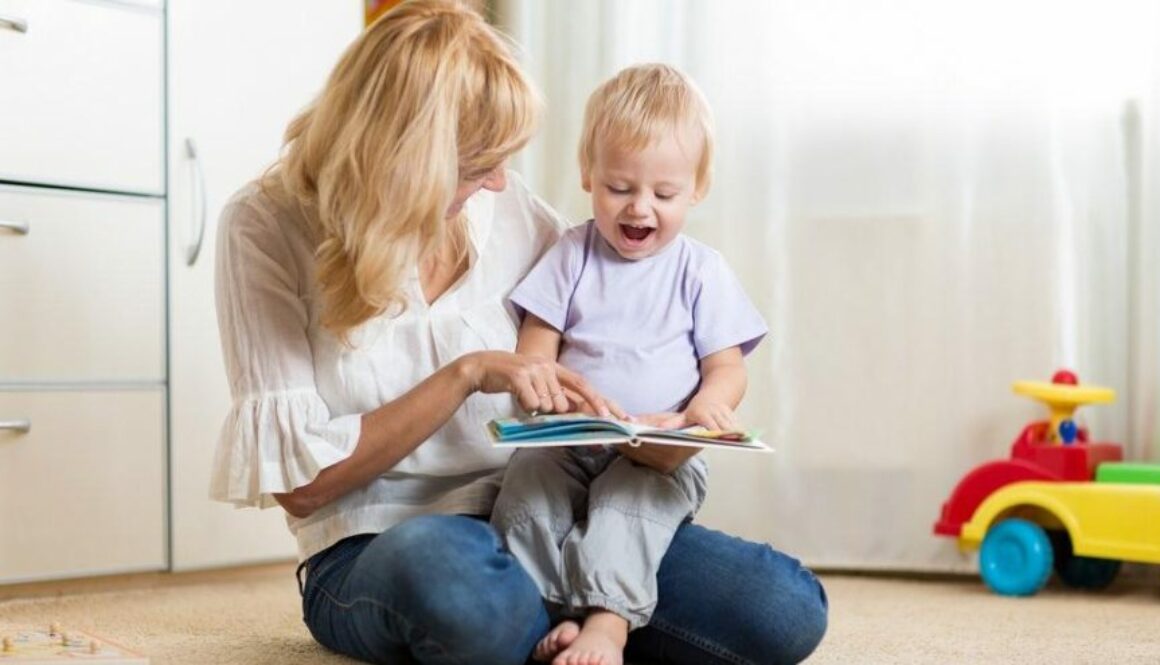
Book reading is important at every age and there is no such thing as starting too early! Research has shown that book reading helps increase your child’s development in so many areas! Maybe your little one doesn’t understand all the words yet, but that’s okay! Secret tip: you actually don’t have to even read all the words! Make book reading fun! Get animated, use facial expressions, act out the story, make noises that may go with the story, and label objects and things happening the picture! Storytime is a wonderful way to connect and bond with your baby. Read more here.
7. Play with your baby.
Play is one of the most important ways we learn. We learn through experience, so get down on the floor, get outside, get creative and PLAY! This is another great way to boost you child’s development across so many areas! There are so many benefits to play, some of which include: increased imagination and creativity, increased social-emotional development, increased physical and cognitive development and a way to interact with the world that allows for exploration through the senses. Play is great because it incorporates so many modalities of learning, including motor movements, visual skills, social-emotional skills, problem solving and of course so many opportunities for language learning! Learn more about the connection between play and language development here!
8. Let your baby lead.
Following your baby’s lead is a great way to understand their likes and dislikes. It gives you an opportunity to see how your baby interacts with the world around them and gives your baby the opportunity to grow! When you are out for a walk and your baby points up to the airplane in the sky, follow your baby’s verbal and visual cues by labeling and expanding “Airplane. Fast airplane.” Letting your baby lead means really staying present and connected to what your baby is doing in all moments, and chances are, all these precious moments are filled with language boosting opportunities!
9. Give your baby choices.
This is such an important tip, but sometimes the hardest for parents to follow. As a parent, you know exactly what your baby wants and needs and so when you see your little one is getting a little worked up, you give them exactly what they need to feel comfort and calm. Although this is absolutely incredible, it sometimes also becomes a missed opportunity for language. Before your little one gets into a distressed state, give them a choice: “do you want apples or banana”-it would be ideal if you can hold up each object as you name it too! When your child is presented with a choice, they are more likely to communicate their wants and needs because they need to indicate to you their choice! Remember, there are many forms of communication, if you baby looks at the object, points to it, or tries to label it those are all great ways to communicate. When giving your little one choices, first make sure that your baby understands the vocabulary. Also, get creative! Communication comes in so many forms and is not just talking. I love to use both verbal and visual cues to help support a child in their speech sounds and language development. Bonus tip: if your baby points to the apples, hold the apple close to your mouth and say “A-PO” and really exaggerate your mouth movements. Try 1-3 times and see if your kiddo imitates, if they don’t, give them a little piece of the apple and try again! This simple snack activity turns into a teachable moment where you are taking each apple slice (maybe up to 10 slices or 20 chunks of apple) to target the sound “a”, the word “apple” or maybe even the phrase “more apple” with your little one! Another example: if your little one wants milk, rather than giving your baby a bottle when they cry, ask them if the would like “more milk” and then encourage their participation in choosing it. This takes a bit of practice and rewiring, but once you get it down, you will see how great it is in encouraging your little one’s speech and language skills.
10. Expand your baby’s language.
Language expansion is a great tool to help your little one develop their expressive language skills. Expansion is when you take what your little one is saying and then add more language to it. When your little one is talking using 1-2 words to communicate, you can imitate what they say and then expand it. For example, if your little one says “car,” you can expand by saying “yes, that’s a green car.” If your little one says “more juice,” you can say “want more juice, okay-here you go!” Putting emphasis on certain words and using parantese (see tip number 5), helps draw your little one’s attention to new words and keeps them engaged!
Language opportunities are happening around you and your kiddo all the time. Now that you have become more aware of these natural moments, you will be more present to when they are happening. Remember, your little one’s speech and language develops in its own time, so just be patient and trust the process. Plus, you now have 10 wonderful ways to boost your kiddo’s language in any given moment! So, print these tips out, put them on the fridge and have so much fun connecting with your kiddo!
Sholeh Shahinfar is the founder of Valued Voices, and a licensed Speech Language Pathologist, Child Communication Specialist and Certified Oral Motor Therapist. She is passionate about uplifting children’s voices in the world and inspiring self-expression. In her free time, she loves going to the ocean, exploring nature with her pup Kobe, and spending time with her family and friends!
Should I allow my toddler to use an iPad? Are apps okay to use for teaching? Is it okay to give my child my phone or tablet when we are a restaurant? How much screen time is okay for my kiddo? How much screen time is too much?
I get asked these questions daily! The truth is, we are living in a world that is moving more and more towards all things technology. As adults, most of us always have our phones within arm’s reach and in fact, we often feel like we have lost something if we don’t have our phone right next to us. The number of hours spent on devices has especially increased during the past year with the rise in distance learning. So, this poses the questions: how much screen time is too much?
To start, the behavior we model matters! Your child is watching and observing you from infancy, as they grow, they want to imitate their number one companions so they begin to imitate the actions they observe. Limiting your own technology use and spending more time interacting and connecting with family and friends will spark the desire in your little one to do the same. Simple things like turning off the TV and instead creating a fun play routine are ways to inspire your little one to seek out more connection and communication with others.
For children under 18 months of age, avoid the use of screen time all together. Video chatting, through platforms such Facetime, Whatsapp or Skype, can be used in moderation, for example: if a parent is out of town or a long distance grandparent. Pediatricians report that video chatting with family members can help build relationships, however, the AAP reports that more studies are needed to determine the cognitive and behavioral impacts of too much screen time, particularly with babies and toddlers.
If choosing to introduce media to little ones 18 to 24 months of age, parents should choose high-quality programming, always be present, and more importantly be interacting and playing with their children. Devices should not be a replacement for interactions, but rather a shared activity and experience.
For ages 2 to 5 years old, doctors recommended 1 hour or less per day of screen time, and urge parents to continue choosing high-quality programming and to continue parent involvement: watch the program with your little one to help them understand what they are seeing.
According to Pediatric Opthalmologist Dr. Charlotte Gore at the Gavin Herbert Eye Institute, when using screens-including televisions, computers, phones, tablets, and game consoles-you are engaging in what is referred to as near work. “Studies suggest that the more time you spend on near work the higher change you have of getting myopia, or near-sightedness.” Increased screen time can also lead to eye strain and fatigue, as well as dryness, irritation and often headaches.
According to the American Academy of Child & Adolescent Psychiatry (AACAP), in the United States, children between the ages of 8 to 12 years old, spend on average, 4-6 hours per day watching/using a screen, and teens spend up to 9 hours.
In addition to eye fatigue, prolonged screen time may also lead to:
Not enough physical activity
Weight changes
Sleep changes
Mood changes
Reading fewer books
Changes in social skills
Lower grades in school
Less time interacting with others
As with developmental milestones, the above are recommendations based on research, but ultimately the decision is yours to make. I have had so many parents tell me that they strictly followed guidelines with their first child, but with their second they just handed over the iPad without thinking twice. We all have do what we have to do in order to get through the day or a tough moment, so don’t be too hard on yourself if one day, you slip up and your little one has had over an hour of screen time. You are human, you are perfectly imperfect, and you are learning, so please gentle with yourself. Below are some additional tips to keep in mind when it comes to screen time:
Spend more time engaging in book reading and play based activities with your children
Always supervise and familiarize yourself with the program to make sure the content is appropriate for your child’s age
If/When using screen time for learning, make sure you are interacting with your child. Talk to them about what you see, make comments, ask questions and make connections to real life events/situations.
Turn off all screens during family meals
Turn of all screens during family outings
Avoid using screens as a means to reduce/avoid tantrums
Turn off and remove screens 30-60 minutes before bedtime
Ultimately, this is a personal choice, but always having the research to help support and guide our decisions is essential. Personally, if you ask me, I am not a huge fan of using iPads in my sessions, nor does any of my team. However, we do know that for some kiddos, it is a huge reinforcer and motivator so we may play one song on our phone or computer when we are transitioning between activities, as a quick break, or a way to create more opportunities for language and learning.
So really, the important question isn’t “how much screen time is too much”, but rather “how is my child being as part of this world?” According to a study by Microsoft, the average human being now has an attention span of eight seconds, which is a big decrease from the year 2000 when the average attention span was 12 seconds. So, if you want your little one to grow up being curious about others, exploring nature and the world around them, and discovering more about themselves and their role in this world, then definitely limit the hours of screen time, get outside, read books, play with toys, and constantly interact with your little one. Although there are great apps and programs out there to help support your little one, in my opinion, the best person to teach your kiddo is YOU mom and dad and the best tool for teaching is imitation and experience!
Sholeh Shahinfar is the Founder of Valued Voices, a licensed Speech Language Pathologist, Child Communication Specialist and Certified Oral Motor Therapist. She is passionate about uplifting children’s voices in the world and inspiring self-expression. In her free time, Sholeh embraces a vegan lifestyle, loves going to the ocean, exploring nature with her pup Kobe, practicing yoga, traveling, and spending time with her loved ones.
The Fisher-Price Laugh & Learning: Learning Piggy Bank is one of our biggest hits at Valued Voices! We love this fun, interactive toy for so many reasons! Designed for kiddos 6 months to 3 years, this piggy bank introduces your little one to counting, colors, animals, shapes, size, sounds, and actions. Your child will light up as they use play to learn! Below are just a few of our favorite ways to use this piggy bank with our kiddos at Valued Voices.
Understanding Concepts:
have your child “point to” or “show me”: colors, animals, numbers and follow simple commands (“put the cow in the bank”)
Labeling:
place the toys in the piggy bank and take a coin out one-by-one; your little one can then label the color, number and/or the animal they see
Ways to expand: ask your kiddo what noise the animal makes (“what does the cow say”)
Combining 2-3 word:
Narrate what your child is doing using simple language (i.e. “push nose”, “cow in”, “coin out”, “open/close door”, “blue sheep”, “yellow duck in”, “take out cow”)
Requesting:
Your child can use “I want” to request a desired coin using 3-4 utterances
Answering WH-Questions:
parents can ask a wide variety of WH-questions during this game to help their children understand various concepts. WH-Questions are a pre-cursor to literacy skills and narratives.
Example:
WHERE: Where should we put the coin? Where is the green coin?
Use the I Spy Dig In to encourage your little one to discover, explore, learn and grow through play!
Every game has it’s set of directions to follow, but there are always ways to adapt games to increase learning and language opportunities for your little one! I Spy is a classic game, loved by many households and classrooms around the country. Children and families bond together in an interactive game that not only is fun, but promotes so much language and learning as well! Below is a list of some ways Valued Voices loves to use this game to stimulate language and learning while still having fun! Give them a try the next time you play:
1. Describing Objects:
Children are learning how to talk about objects, instead of just labeling them. This helps with learning object attributes (like size, shape, color, etc.), as well as object functions, categories, and even begins to address “wh”-questions.
Example: Bike
Object Function: It is something you ride
Category: It is a vehicle/transportation
Object Attributes: It is green and blue, it has pedals, it goes fast
WH-Concepts: you can find it outside, in a garage, or in a store”
2. Learning Colors
3. Increasing vocabulary for objects, adjectives, and concepts
4. Answering WH-Questions:
Parents can ask a wide variety of WH-questions during this game to help their children understand various concepts, such as person, place, thing, time, function, etc. WH-Questions are a pre-cursor to literacy skills and narratives.
Example: Bottle
WHO: Who uses it?
WHERE: Where do you find it?
WHEN: When do you use it?
WHAT: What do you do with it?
WHY: Why does a baby need it?
5. Social Skills & Higher-Level Language:
Turn taking
Perspective taking
Making inferences and Reasoning
There are so many ways to keep this game fun, while creating opportunities for language development and self-expression!
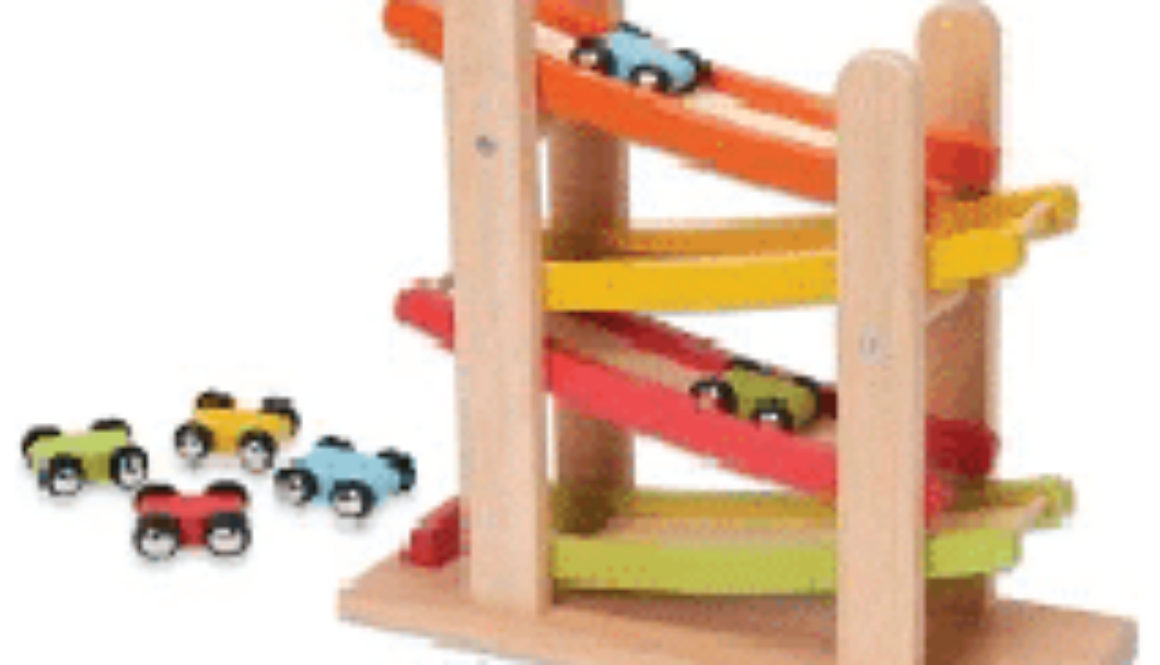
Use the Junior Ramp Racer to encourage your little one to discover, explore, learn and grow through play!
Once your little driver gets a hold of this toy, they will be racing to get to the finish line! The wonderful Junior Ramp Racer is an incredible and fun way to target speech, language, communication and learning! Designed for kiddos 18 months to 4 years, this car ramp introduces your little one to numbers, colors, actions, and concepts such as “fast” and “slow” and “on” and “off.” Below are some of our favorite ways to use this car ramp racer with our kiddos at Valued Voices:
Speech:
You can target lots of speech sounds with this fun toy (ex: /k/ for “car” and vowel sounds “uh” for “up”, “ah” for “on”).
Language:
Identifying Colors: hold up two colored cars and ask your child to “point to/touch the blue car”. You always want to make sure your kiddo can identify a color before expecting them to use it.
Following Directions: You can also have your kiddo follow command (ex: “Put the green car at the top of the slide”).
Labeling: have your kiddo label the colors, numbers, objects and actions
Requesting: have your kiddo request using 1-4 word combinations. Depending on where your little one is at, they can request using the color (ex: “red”), the color+object (ex: “red car”), or the 3-4 phrase: “I want (red) car.”
Combining words to make phrases/sentences: your kiddo can describe what he/she is doing “car go down”, “car on slide”, “push green car”, as they are playing
Answering Questions: begin to introduce or expand on “WH” and “yes/no” questions (example: “do you want/is this the yellow car”, “where is the car”, “what color is it”)
Communication:
This toy a great way to encourage turn taking and using the phrases “my turn” and “your turn”.
Learning:
This one toy is embedded with tons of learning and educational concepts! Some examples are: colors, numbers, fast/slow, up/down, top/bottom, on/off, and go/stop. How many others can you come up with?